
Is Brazilian Farofa Healthy? Nutrition, Taste, Recipes & More
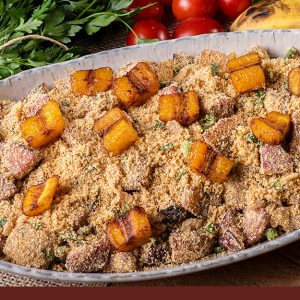
Farofa is one of the most popular foods in Brazil, and with good reason. It’s delicious, it’s simple to make, it’s an excellent topping for a huge variety of meals, and it enhances any dish you put it on. We’ve even written about it before, so if you want a rundown on the culture and popularity of the dish, you can check out that post here.
That said, there’s one big question you might have: is it healthy? In an increasingly health-conscious world, you might not want to eat farofa if it’s full of bad nutrients or excessive sodium, right?
Let’s run down everything you need to know about farofa, including whether or not you can enjoy it without concern.
Table of Contents
What is Farofa Made Out Of?
We are what we eat, so what is farofa made out of?
The primary ingredient is the starch from a root vegetable widely cultivated in Brazil. That vegetable is known by several names, including manioc and yuca, and the flour made from grinding the root is known as tapioca. Most commonly, though, the plant is known as cassava.
Whatever the name, the roots are grown, harvested, and processed before being turned into a flour-like substance. That flour is then used in a bunch of different ways, including as the base ingredient of farofa.
Fun fact: Cassava is native to central Brazil and has been domesticated as a staple food item for at least 10,000 years! How’s that for longevity?
Of course, there’s a lot more to farofa than just the cassava flour.
There are two main “versions” of farofa: the version used as a topping with relatively few other ingredients, and the version full of other goodies served as much as a dish itself.
Farofa as a Topping
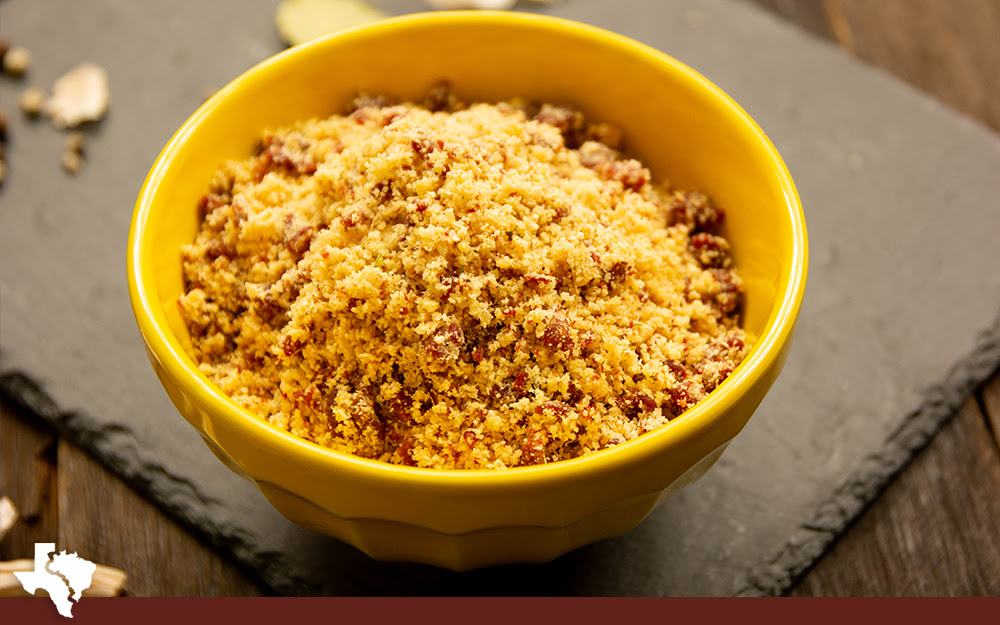
The “lite” version of farofa, sometimes also known as farinha (the Portuguese word for flour), is commonly found pretty much everywhere throughout Brazil, and it’s one of the staple sides we have available in the salad area of our restaurants here at Texas de Brazil.
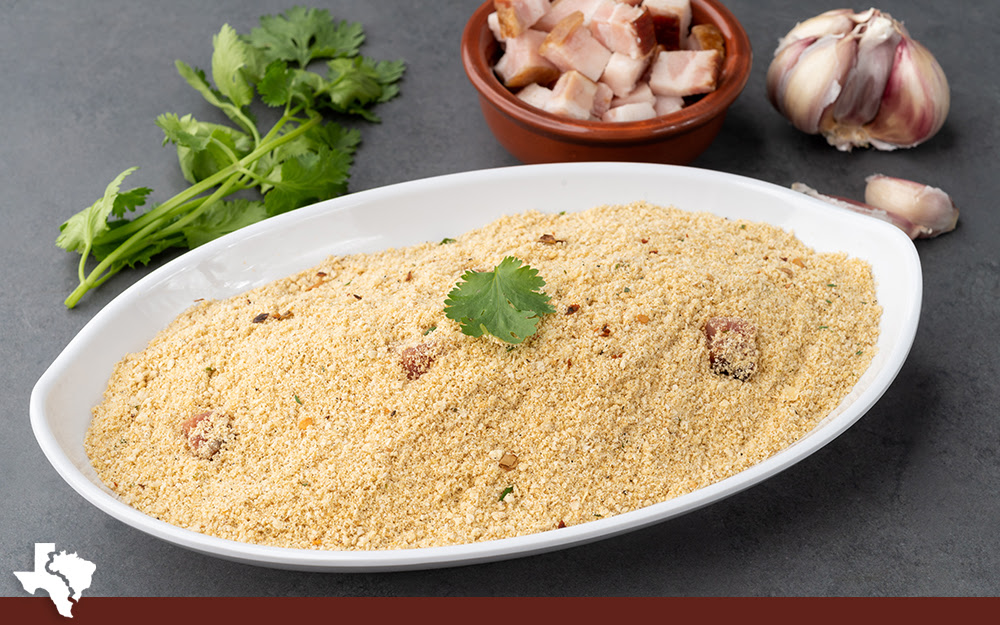
The ingredients involved in making it are almost entirely for flavor and texture, rather than substance.
- Butter, to provide some fat and bring the farofa together.
Technically, you can stop there! The simplest possible farofa recipe (the one more commonly seen as farinha) is just cassava flour and butter, with a little salt if the butter is unsalted. For most farofa recipes, though, you’ll have at least a couple more ingredients.
- Onions and garlic, for that ever-popular aromatic addition.
- Bacon, for a rich meatiness and smoky flavor.
- Salt and pepper, which enhance every dish.
And that’s it! The combination of rendered bacon fat and butter helps the cassava flour clump up into the breadcrumb-like texture we know and love, and the other ingredients add flavor to the crumbs. It makes for a perfect addition to basically every dish, because really, who doesn’t love a spoonful of rich, smoky goodness?
Farofa as a Dish
Farofa, when served as a side dish, has a lot more going on. It’s also one of those recipes where seemingly every family has their own variation, so there’s no real way to go wrong with it.
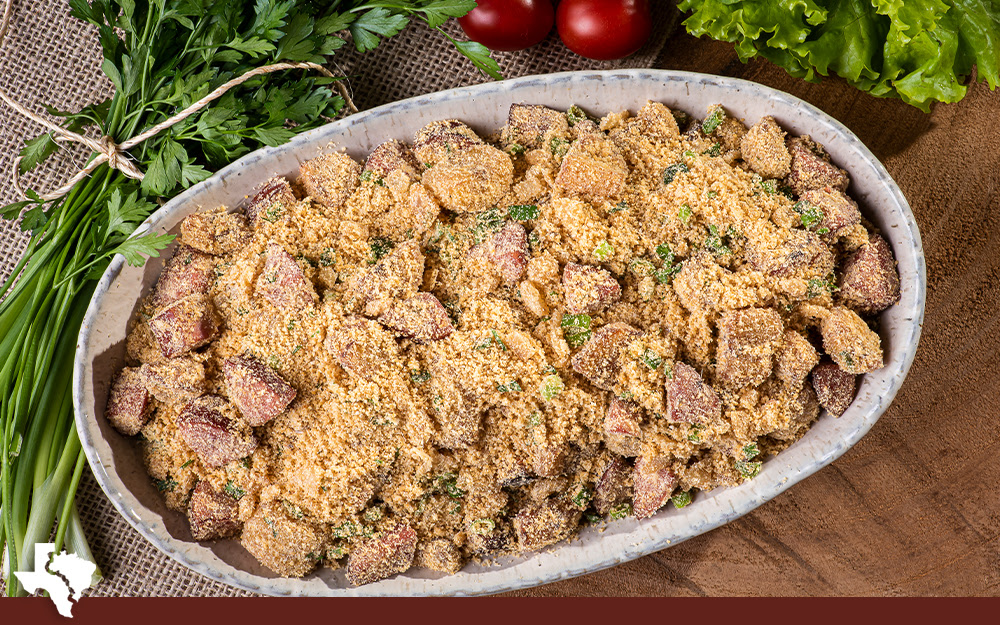
What goes into it?
- Onions (or shallots) and garlic, just like above.
- Bacon, also just like above.
- Butter, because, of course, you need butter for this.
- Eggs, beaten and scrambled into the dish like fried rice.
- Olives, for bits of salty, brine flavor. Kalamatas are common.
- Dried fruit, usually raisins and/or cranberries, for a sweet addition.
- Scallions, usually as a topping and garnish.
- Salt and pepper because, again, it helps everything.
That’s a common recipe, but it’s far from the only one. We’ve also seen farofa recipes that include:
- Herbs like parsley and chives.
- Red and green peppers, for a more vegetal variation.
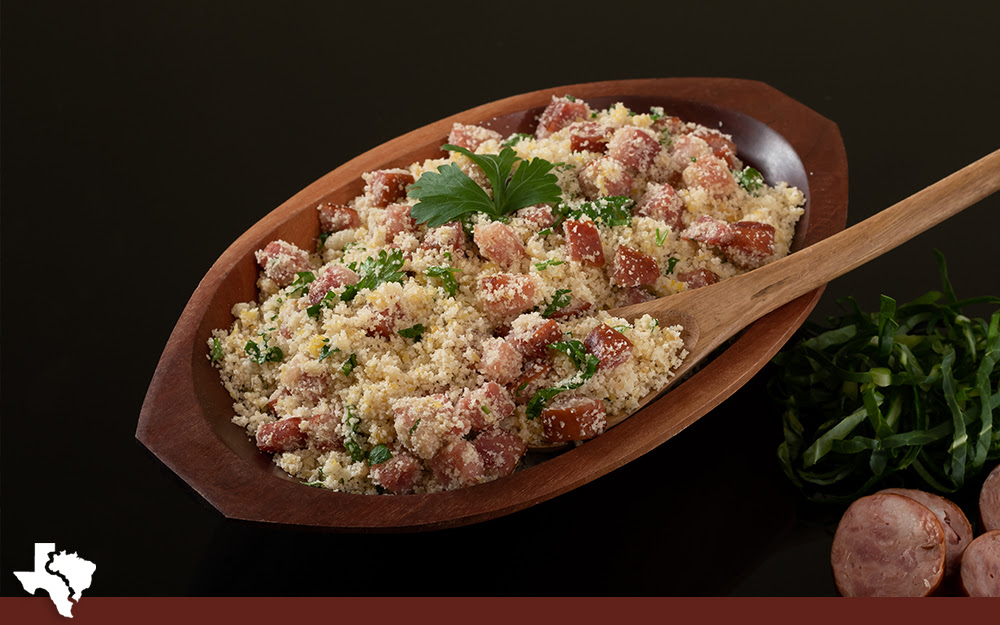
- Sausage or salami, for a more complex meat flavor.
- Carrot, to add to the onion for a more French-adjacent take.
- Bananas, for a dessert version of the treat.
- Walnuts, for a different kind of crunch and flavor than the farofa itself.
As you can see, there are a million different variations. Even the way you cook the eggs or the kind of olive, onion, or fruit you use can change. If you’re looking to make some yourself, feel free to experiment to find what you like the most!
What Does Farofa Taste Like?
To us, it tastes like home. To others, it tastes like smoke and butter, salt and onion, or ” tasty sawdust“.
Farofa tastes largely like what it’s made out of.
Cassava flour itself is a very neutral flavor, slightly earthy, occasionally mildly nutty, but not very strong at all. It really is a lot like the all-purpose flour you’d get for baking in that sense, and it’s very much an ingredient.
Farinha’s primary flavor, then, is just the butter used to bring it together. And hey, who could ever complain about the flavor of butter?
Farofa adds in the flavors of alliums, the garlic and onion we all know and love, and the meatiness and smoky flavor of bacon. None of this is exactly unusual in American cuisine, much of which starts by sauteing onions and garlic, and we all know our good friend bacon.
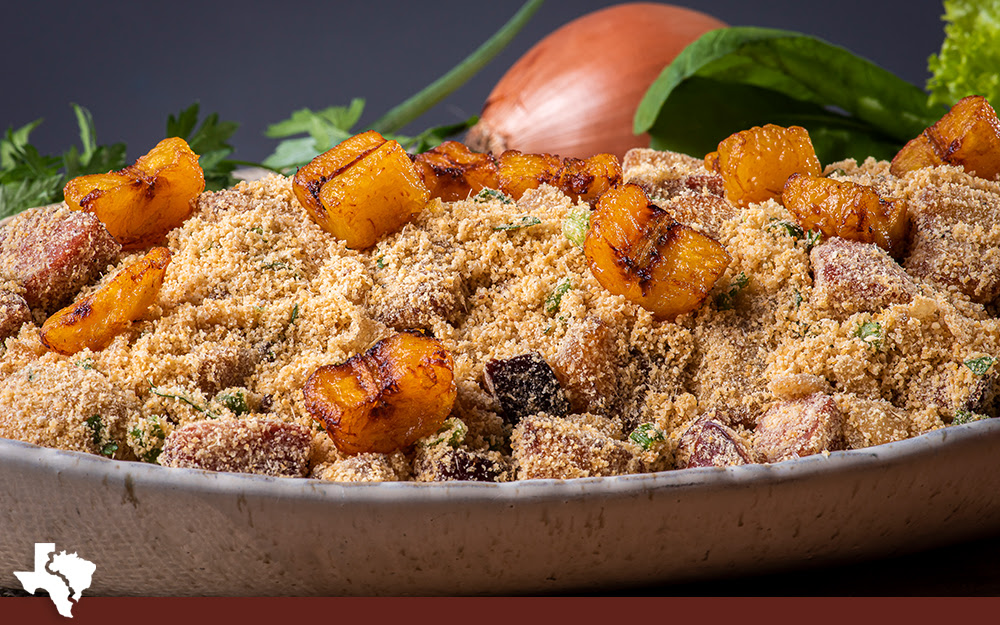
Why is farofa such a cultural icon if it’s so simple?
For that, you’ll want to read the article we linked above, but the short version is: it was a cheap staple carbohydrate, similar to rice and corn in other countries, and the simple flavors were readily available and easy to use as a food source even in times of scarcity, poverty, and famine.
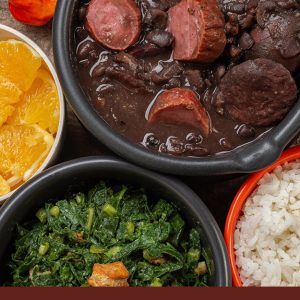
Really, though, most of the time, Brazilians aren’t adding farofa to their meals for the flavor so much as they are for the texture. We’ve described it like breadcrumbs before, and that’s really the most appropriate descriptor. It’s a little crunchy and a little grainy, without being tough to eat. It adds crunch to foods that don’t normally have it, like feijoada and churrasco meats.
What is the Nutritional Profile of Farofa?
Farofa has some pros and some cons when it comes to its nutritional profile.
At the heart of the meal is the cassava flour. Cassava is a root, a starch, a vegetable, and most of all, a carbohydrate. Of the three macronutrients, carbohydrates are the highest. Fats follow second, since the secondary ingredients in farofa are butter and bacon, which bring a lot of fat into the equation. Protein comes in third, carried mostly by the bacon and additions like eggs if you’re going for a robust farofa recipe.
While the specific nutritional profile of farofa will vary according to the recipe, we can at least give you the nutritional facts for ours:
- 50 Calories
- 30 Calories from fats
- Total fat: 3.5 g
- Saturated fat: 2 g
- Trans fat: 0 g
- Cholesterol: 20 mg
- Sodium: 45 mg
- Carbohydrates: 5 g
- Dietary fiber: 1 g
- Sugar: 1 g
- Protein: 1 g
That’s for one tablespoon of farofa using our recipe.
All of those numbers are pretty low, including the serving size, but that’s because farofa is a topping. You aren’t putting very much of it on your food when you enjoy it.
Farofa also has a couple of benefits.
For one, it’s gluten-free. Cassava flour is actually widely used as a gluten-free alternative to wheat flour, and can be used to make everything from cookies to bread. In fact, another Brazilian favorite, pao de queijo, is a Brazilian cheese bread that our patrons love.
Baseline farofa can also be free from soy, and even from eggs, though specific recipes like ours might not be. Be sure to check our nutritional information and err on the side of caution if you have allergies to those kinds of ingredients.
Sadly, two ingredients are core to farofa that you can’t really avoid: butter (dairy, and thus milk) and onion. If you’re one of the unfortunate souls allergic to one of those ingredients, you’ll want to hold off on the topping.
Is Farofa Healthy?
This is a tricky question to answer, honestly. For the most part, we’re going to consider farofa as a topping, and not the whole dish, which is too variable to pin down easily. If you want to analyze farofa as a stand-alone dish, you’ll need to consider all of the ingredients.
Farofa is carb-forward, which means it’s not suitable for low-carb or no-carb diets. At least, no-carb diets. Low-carb diets can still enjoy a little farofa as a treat, since you really only eat so little of it that it’s barely a blip on your daily carbohydrate intake. A typical low-carb diet aims for under 50 grams of carbs per day, and a whole tablespoon of farofa is around 10% of that.
Farofa is also relatively low in fat. 3.5 grams of fat in a tablespoon is a pretty small amount, when you consider an average diet should be consuming around 50-78 grams of fat per day. It’s free of unhealthy trans fats, too.
Since farofa is low in protein, you aren’t getting enough protein from it to really be meaningful. And really, if you’re having it as a topping for something like churrasco, or a mix-in for feijoada, you’re getting way more protein from the base food than the farofa.
One thing you might have heard about is that cassava, the root, contains certain compounds that can be toxic. In fact, when first harvested, those compounds react with oxygen in the air and form cyanide.
That’s actually not all that bad, though. For one thing, a lot of foods contain a little bit of cyanide, or compounds that can turn into cyanide, including sorghum, bamboo shoots, rhubarb, potatoes, and lima beans. In tiny amounts, it’s effectively harmless; your body is more than capable of removing the little bit you might get from a meal, or even from the air you breathe. People who smoke cigarettes get way more cyanide than you’d find in a meal with every drag.
More importantly, the way cassava is processed removes the compounds that cause cyanide to form. Some tiny amounts might make it through, but the majority is gone. Cyanide is only a concern in cassava if it’s very improperly processed, and that’s quite rare.
So, put your mind at ease; cassava, at least the kind that makes it to market, is not toxic in any way that matters.
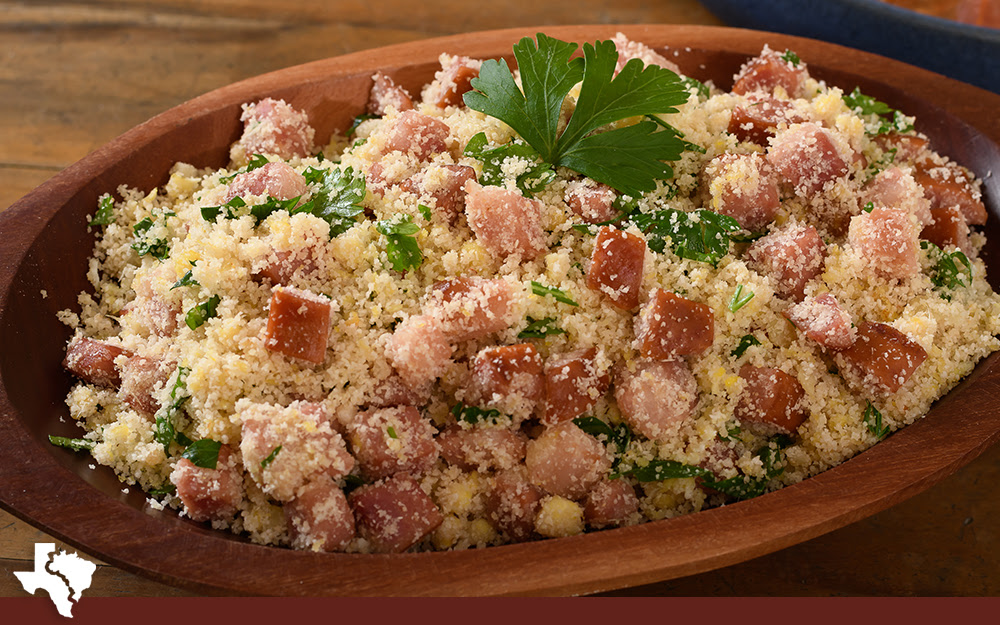
So, is farofa healthy?
Well, it’s not unhealthy. It would be if you were to chow down on a bowl of it, but that’s not what you’re going to do, is it? Even the meal-focused farofa recipes are largely made of other ingredients, and the farofa serves as a sort of crust, like tempura or panko.
There’s also an argument to be made that farofa is one of the better carbohydrates to enjoy. Cassava is low on the glycemic index, which puts it ahead of some other kinds of carbs.
When you get right down to it, the fact is, you probably aren’t eating enough farofa at any given time for it to be really impactful towards your diet one way or the other. The only thing you might be concerned about is the sodium, and that’s going to be true of pretty much every Brazilian food that isn’t primarily made out of sugar.
Interested in trying it for yourself, to see what all the fuss is about? You can bet that farofa will always be available in our salad area here at Texas de Brazil. We wouldn’t be a Brazilian restaurant without it, after all! So, find your nearest location and plan a trip! You can call ahead or use our web form to reserve a space, or you can stop by whenever you get the chance. Don’t forget to join our eClub for special deals and offers! We’re sure you’ll love what we have on offer, so we look forward to serving you.