
Are Brazilian Restaurants Considered Halal or Kosher?
When it comes to food, everyone is different. Dietary restrictions are a big part of how we all choose what to eat, and depending on the restrictions, it can be relatively easy or surprisingly difficult.
Broadly, dietary restrictions can be grouped into three categories.
The first is simply preference. People who don’t like onions, or don’t care for tomatoes, or are picky about vegetables, or don’t like spicy foods. Often, the diversity of foods available at a restaurant like a Brazilian steakhouse means there’s something for pretty much anyone.
The second category is sensitivities and allergies. Nut allergies, gluten allergies, and allium allergies are all relatively common. Some restaurants can cater to these allergies, while others can’t. Here at Texas de Brazil, we pay attention to allergies, and our staff are happy to assist you with picking appropriate menu items. We also have an online portal dedicated to allergen information.
The third category is social. This is where your cultural, moral, and religious restrictions come into play, ranging from veganism to kosher to halal. As you might have guessed from the title of the post, this is what we’re going to talk most about today.
So, are Brazilian restaurants like Texas de Brazil considered kosher or halal? Read on to find out.
Table of Contents
What is Halal?
Halal is primarily associated with the Islamic religion and is part of the dietary restrictions that come as part of Islamic religious practice. Those who practice Islam divide life into halal (permitted) and haram (forbidden) practices, which include food but are not limited to just food.
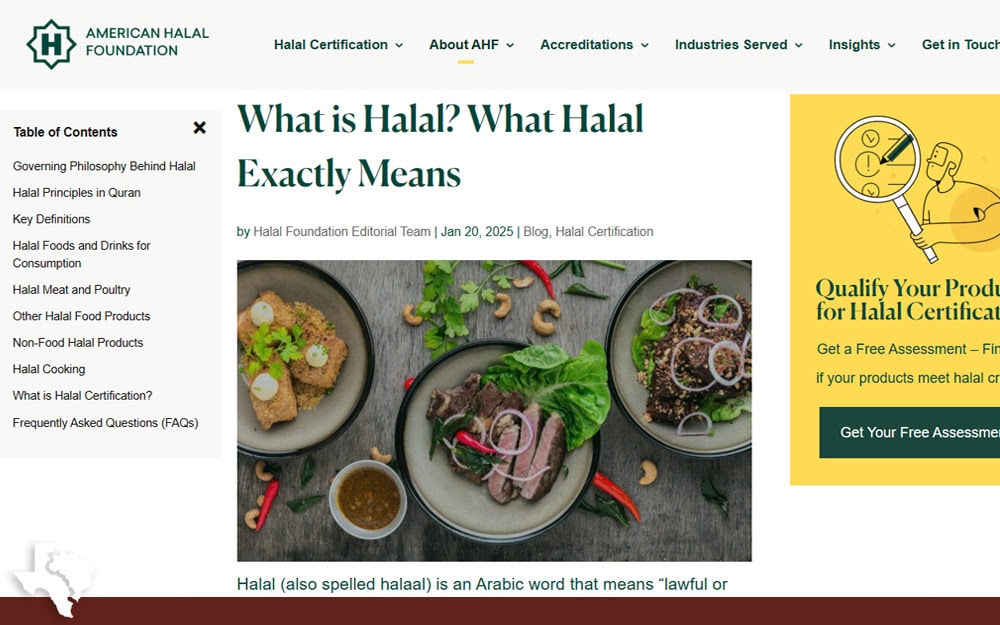
While there’s a lot of nuance to this dichotomy, the most common rule of thumb in English is “ABCD IS”, as in “Everything is halal except ABCD IS haram”. This is an acronym for six things:
- A: Alcohol and other intoxicating substances.
- B: Blood, flowing or congealed.
- C: Carnivorous animals.
- D: Dead meat, or meat not slaughtered and prepared by Islamic practice.
- I: Food Immolate unto idols; the food sacrificed for other religious practices.
- S: Swine and swine derivatives, aka pork, bacon, and so on.
Each of these has an associated passage or several passages in the Quran forbidding it, and anything not explicitly mentioned is considered allowed. There’s also a third group, Makrooh, which is things that are discouraged but not wholly prohibited. Smoking (substances like tobacco, not necessarily smoked meat), for example, is Makrooh.
As far as foods go, Islamic restrictions largely center around meat. Just about everything from the plant kingdom is allowed, except things that are intoxicants, which can include plant-based drugs like opium, or toxic plants (which you shouldn’t be eating anyway, and which you won’t find on a Brazilian restaurant’s menu for obvious reasons.)
For meat, the main differentiator is the means of slaughter. Islamic guidelines require invoking the name of Allah during the process, and using a humane cut to the throat to kill and drain the blood from the animal. Removing the blood properly is a big part of making the meat halal.
Certifying meat as halal is multifaceted. It’s meant to be a gesture of respect for the animal giving its life for our sustenance. It’s meant to minimize the suffering of the animal through a single fast cut. The consumption of blood is prohibited, hence the exsanguination. And all of this also ties into cleanliness, methods that helped promote food safety before modern food safety was understood.
Are Brazilian Restaurants Considered Halal?
Unfortunately, generally speaking, Brazilian restaurants aren’t halal by default.
If you think about Brazil and religion, what comes to mind? Well, one thing that likely stands out is the world-famous giant statue of Christ the Redeemer, which is decidedly not an Islamic monument.
The fact is, Brazil has had a very contentious history with Islam. Many of the slaves brought over from North Africa practiced Islam, and in the 1800s, a significant slave rebellion called the Male Revolt occurred. In response, Brazilian authorities broadly suppressed the Islamic faith. Today, less than 0.1% of Brazil’s population practices Islam. While the number is growing year over year, it’s still a very small portion of the population.
What this means is that Brazilian food culture is not heavily influenced by Islamic practices, and most restaurants are not going to cater to such a small fragment of the population. Certainly, some restaurants do, and 0.1% of Brazil’s population is still around a quarter of a million people. Some areas have dedicated halal restaurants, or at least a selection of halal menu items.
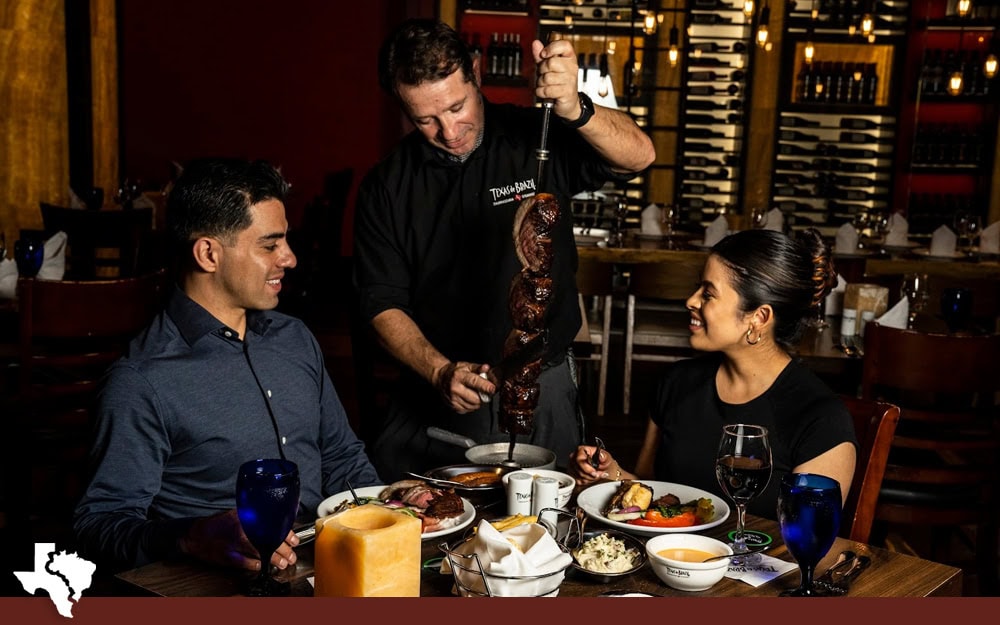
What about us specifically, here at Texas de Brazil?
Unfortunately, the halal options in our restaurant are limited to the salad area. While meats can be made halal, only our lamb is certified halal when we buy it. But, due to the reuse of the skewers we cook our meats on, the same skewers that touch pork also touch the lamb, rendering it no longer halal.
To be clear, this doesn’t mean that the meats we serve are dirty or unethical. It just means that they weren’t certified as halal in their production. Modern slaughterhouse methods are about as ethical as you can get via mass production, and use a captive bolt system to stun the animal so they don’t feel pain in the process; a single cut and draining of the blood is also used. But most meat isn’t slaughtered by a Muslim and dedicated to Allah, so even if it otherwise meets the requirements, it can’t be certified.
What is Kosher?
Like halal, kosher is a religious set of rules and dietary practices. It comes from Jewish religious law and governs foods, ingredients, and production methods. The core of kosher dietary law comes from the Torah, as interpreted over the centuries by rabbis.
It’s likely that there are some historical similarities to, if not the specific practices, at least to the goals and results of both halal and kosher practices. Food safety, for example, is a big one. The root of kosher, though, is about adherence to divine will.
Kosher rules are complex, and centuries of adjudication by rabbinical authorities have made it tricky to maintain a dedicated kosher lifestyle. As with any religious practice, it’s easier in places with significant Jewish populations and harder in those without.
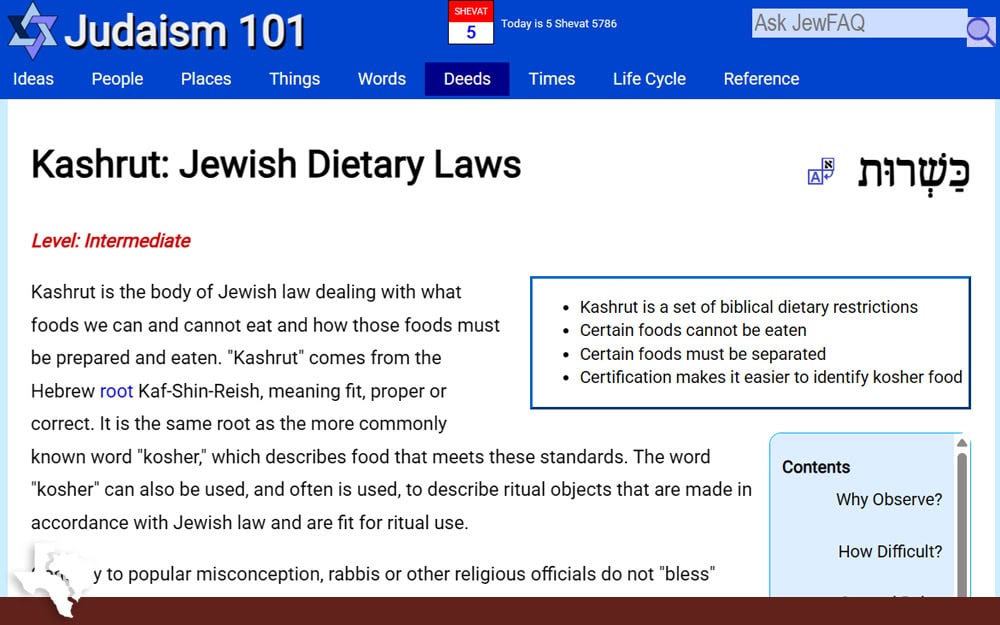
In broad strokes, some of the key rules to keep kosher include the following.
Certain animals may not be eaten at all. Animals with cloven hooves and which chew cud are allowed, which includes cattle, sheep, goat, deer, and bison. Animals that lack one or both of those qualifications are forbidden, which can include animals like rabbits and pigs.
Aquatic animals have their own rules; only animals with fins and scales are allowed. Fish are allowed, but shellfish are not. Even some fish are not allowed, such as swordfish, which don’t have scales as adults (when they would be caught and prepared.)
Poultry is tricky, as there’s no defined rule from the Torah, but it mostly excludes scavenger birds and birds of prey, most of which aren’t commonly eaten anyway. Turkey is a special case; it doesn’t match the other forbidden birds, so some consider it kosher, while others avoid it because turkeys weren’t known by the Jewish people at the time the rules were written, so it’s impossible to say definitively where it would fall.
Animal-derived products from forbidden animals also cannot be consumed. The enzyme used in hard cheeses, rennet, is an animal-derived product, so the animal it comes from must be kosher for the cheese to be kosher.
Kosher animals must be slaughtered in kosher ways. Animals cannot be consumed if they died of natural causes or were killed by other animals, and they must be in good health at the time of slaughter. Like halal, kosher requires a single fast cut across the throat to kill the animal, and blood must be drained. Also, like halal, the slaughter must be done by a pious Jewish man, who often was a rabbi himself.
Despite the similarities between halal and kosher rules, since each requires a specific faith of the person doing the slaughtering, they are mutually exclusive; halal meat cannot be kosher meat and vice versa. Other foods, like vegetables, can be both halal and kosher, but not meats.
Meat and dairy must be separate. This includes a lot of different rules and situations. Cheese, a dairy product, can’t be part of meat dishes. A soup with a cream-based broth can’t have meat in it. A sandwich with meat and cheese is not kosher.
Eggs are not classified as meat for this purpose, so an egg-and-cheese omelet can be perfectly kosher. Fish is also allowed, and one of the stereotypically Jewish combinations of lox (smoked salmon) and cream cheese attests to this.
Conversely, despite the origins of the law coming from a statement to not cook an animal in its own milk, poultry (which does not produce milk) is still prohibited when mixed with dairy.
The separation is severe, too. It’s not enough to have some slices of picanha on one plate and some pieces of cheese on another. Many who keep kosher separate the two by at least 3-6 hours. At least one way, from meat to dairy. If you start with dairy, you can cleanse the mouth with a rinse and an unrelated solid like bread, and then the meat is acceptable.
Kosher applies to utensils and cookware, too. This is a big area where kosher becomes very difficult in a restaurant setting. Utensils and cookware are kosher if the food they’re used to make or handle is kosher. A pan used to cook meat becomes a meat pan; if that pan is then used for anything not kosher meat, it becomes non-kosher and can’t be used for kosher meat.
This is frequently an issue in many settings where cook surfaces like grills, stove tops, and pans come into contact with mutually exclusive foods and become non-kosher.
There’s more beyond all of this (a lot more, honestly), but this much can give you an idea of how difficult it is to keep kosher in a restaurant setting.
Are Brazilian Restaurants Considered Kosher?
Like halal, Brazilian restaurants are generally not considered kosher.
If Islam makes up 0.1% of Brazil, Judaism makes up even less. Brazil had several waves of Jewish immigration throughout its history. Early Sephardic jews came in the 1600s or earlier, with many hiding under the guise of recently converted new Christians. They were forced to leave when Dutch territories were reclaimed by Portuguese Brazilians. Later, Ashkenazi jews immigrated in the 1800s and 1900s in larger numbers, and more came in the 1940s following WW2.
While Brazil is home to the second-largest population of Jews in Latin America, the population in numbers is even lower than our Islamic population, totaling around 120,000 people, for 0.06% of the population of the country. Thus, much like keeping halal, keeping kosher is not something one would expect in Brazilian restaurants outside of specific Jewish areas of major cities like Rio de Janeiro or Sao Paulo.
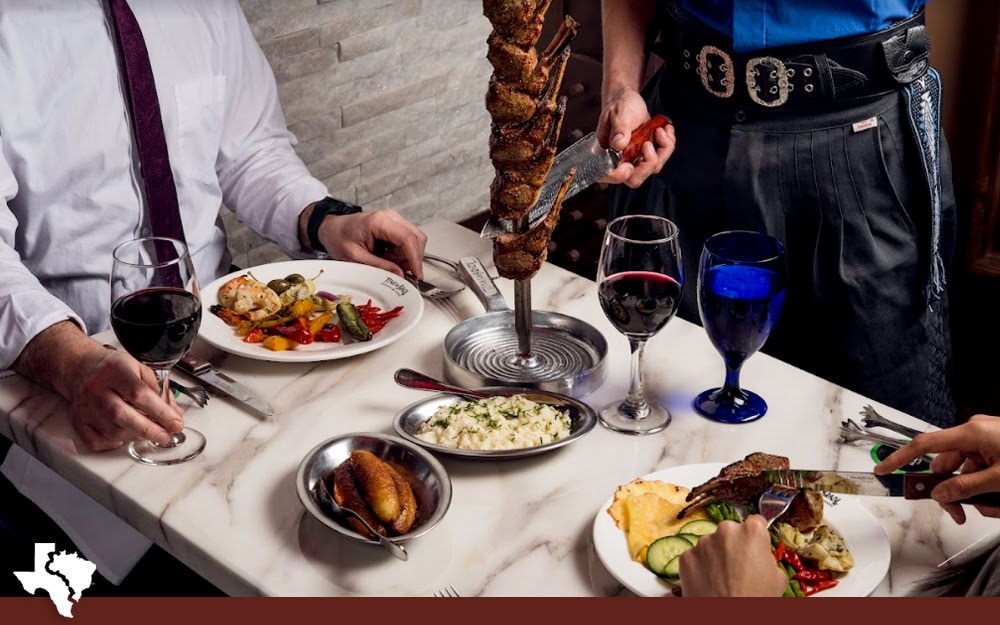
Here at Texas de Brazil, we don’t keep kosher. The challenges associated with restaurant cookware and utensils in particular aren’t part of our process. There is a small chain of kosher Brazilian steakhouses (called Kosher de Brazil), unaffiliated with us, which you might consider trying if you have one near you.
When it comes down to it, though, neither Jewish nor Islamic dietary practices have made a big enough cultural impact in modern-day Brazil to be broadly catered to in our restaurant industry.
Exploring Brazilian Restaurants with Dietary Restrictions
Ultimately, many dietary restrictions come down to individual and personal interpretations. For some, that means we unfortunately have nothing to offer you. For others, you may be able to explore our limited menus, even if the meat isn’t available.
If you have any questions relating to your specific dietary restrictions, we encourage you to give us a call. Simply find your nearest Texas de Brazil location and call using the number listed. Our managers will be happy to talk to you about your specific restrictions, and if there’s any way we can accommodate you in our restaurant.